
Aging in Place in Burlington, MA: The 2026 Guide to Kitchen Appliances That Help You Stay Home for Decades
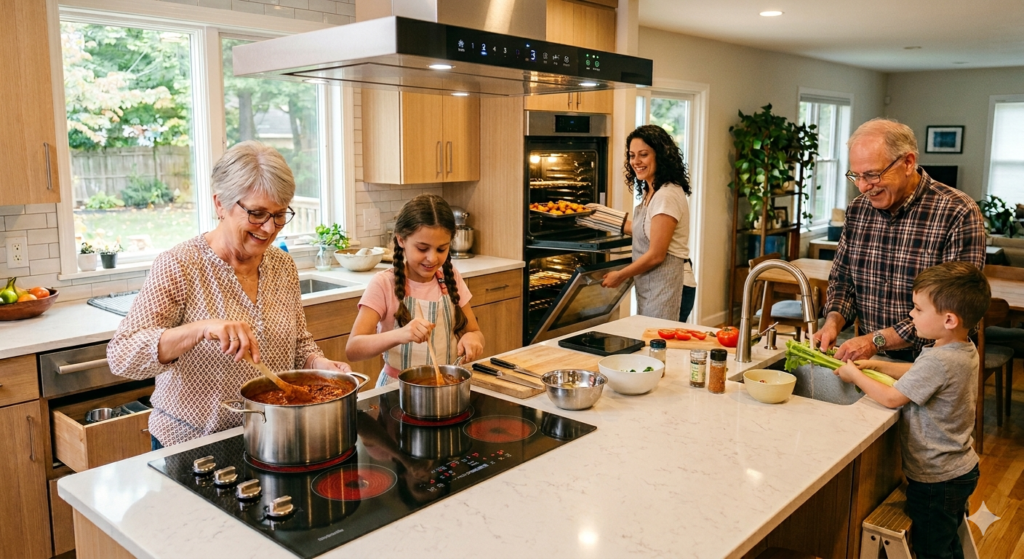
Aging in place isn’t about preparing for the worst — it’s about designing a kitchen that works for every generation.
That preference isn’t anecdotal. The most recent AARP Home and Community Preferences research finds that roughly 77% of adults 50 and older want to stay in their current home as they age — far ahead of every other option, including downsizing, age-restricted communities, or assisted living. For Massachusetts homeowners specifically, where assisted living runs a median of about $84,000 a year, the financial gap between aging in place and moving is striking. The lifestyle gap is even wider.
And yet most kitchens — including most newly remodeled ones — quietly work against aging in place. Top-freezer fridges that require bending. Cooktops with back controls that send arms reaching over hot burners. Wall ovens at floor height. Dishwashers that demand a thirty-second squat to load. None of these are dramatic problems at fifty. All of them become real ones by seventy-five.
This guide is the conversation we have most often in our Burlington appliance showroom: which appliances actually support independent living, what features make a kitchen safer without making it look institutional, and how Massachusetts homeowners can use rebates and the right design choices to plan ahead. Use it as a starting point — then come see the appliances in person.
The Massachusetts Reality: Why Aging in Place Is Already the Default
Three numbers explain why this topic has moved from “someday” to “this year” for so many Burlington-area families. The first is the AARP preference data — more than three out of four adults over 50 want to stay home. The second is demographic: Massachusetts is among the older-skewing states in the country, with about one in five residents now aged 60 or older, and Middlesex County tracks closely with that average. The third is financial — and worth seeing on a chart.
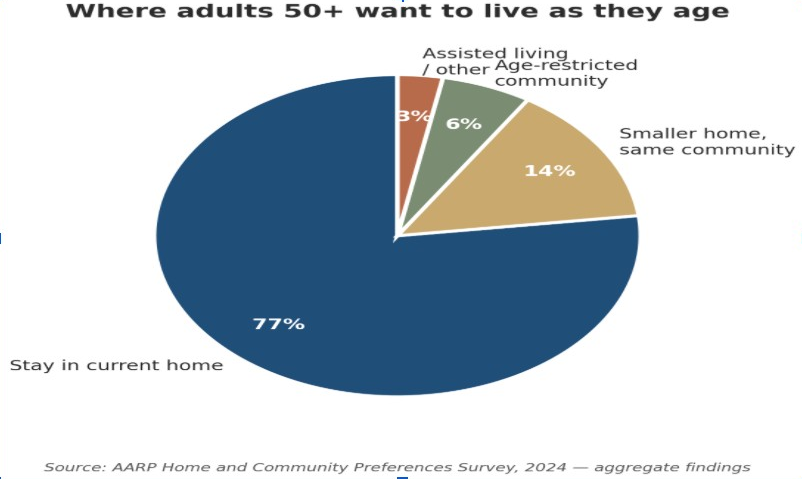
The preference is overwhelming, and it’s stable across income, geography, and household type. Adults across Greater Boston — whether they live in a single-family home in Winchester, a Concord farmhouse, or a Burlington split-level — are choosing the same answer. The question becomes practical: what does it actually take to make that work?
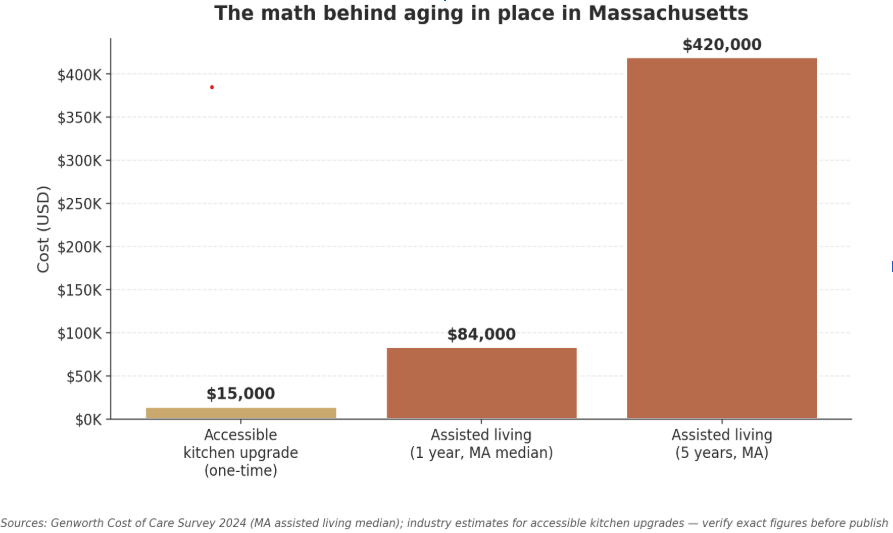
The math is hard to argue with. A thoughtfully chosen accessible kitchen — the kind we help Burlington-area families plan every week — is a one-time investment that’s typically less than two months of assisted living in this state. Over five years, the gap widens dramatically. Spend $15,000 on the right appliances and design now, and the savings versus moving aren’t small. They’re transformative.
What Aging in Place Actually Means When You’re Choosing Appliances
There’s a stubborn myth that accessible appliances are clinical-looking compromises. Beige fronts, oversize labels, the unmistakable signal that someone in the household has lost some ability. That myth is twenty years out of date.
The premium brands we carry — GE Café, KitchenAid, Samsung, Thermador, LG Studio — have quietly made the same features that help an 80-year-old also help everyone else in the household. Front controls so nobody reaches over a burner. Fresh food at eye level so a six-foot adult and a four-foot grandchild can both see what’s there. Pull-out drawers instead of deep, dark cabinets. Soft-close doors that don’t slam at 6 a.m. Touchless faucets that work whether your hands are full of raw chicken or sore from arthritis. None of it reads as “accessible.” All of it is.
The frame we use with Burlington customers is simple: this isn’t about picking elderly-looking appliances. It’s about picking better-designed ones. Universal design, the discipline that powers most of these features, exists precisely because design that works for the widest range of users tends to be design that works best, full stop.
The Seven Kitchen Appliance Categories That Matter Most
Walk through these in order. Some matter more than others depending on your household, but the right combination of these seven decisions sets up a kitchen that adapts as you do, instead of one you’ll have to revisit in fifteen years.
1. Refrigerators — Why French Door Has Become the Standard
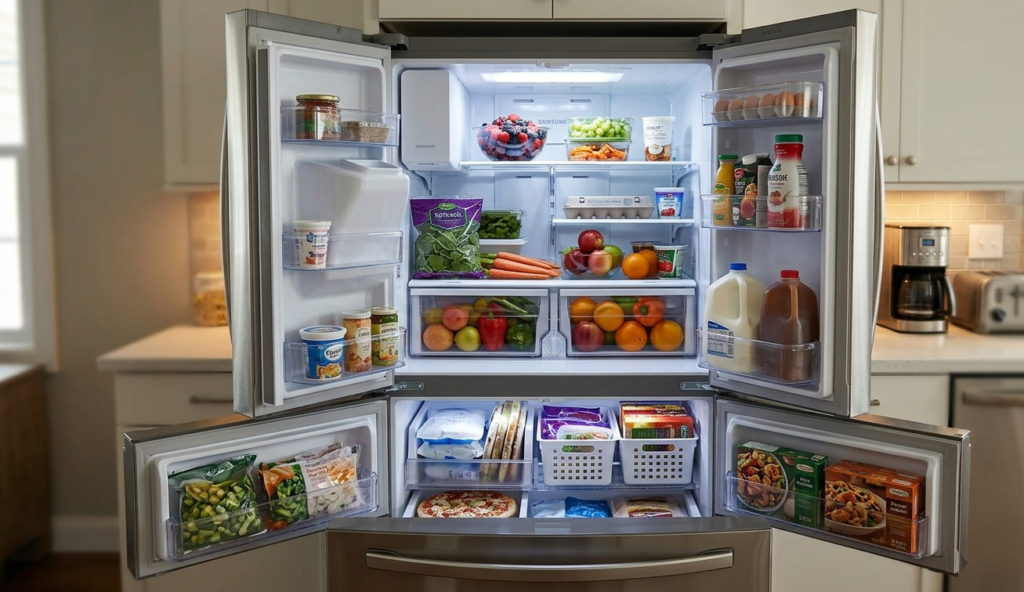
French-door refrigerator opened to show fresh food at eye level and a pull-out freezer drawer.
The single biggest accessibility upgrade in a modern kitchen isn’t a grab bar or a slope-floor shower — it’s the shift from a top-freezer refrigerator to a French-door layout. Fresh food sits at eye level, which removes the daily crouch to find the strawberries. The freezer becomes a pull-out drawer at hip height, which eliminates the awkward reach into a top compartment while balancing on a step stool. Wide shelves let you see what’s at the back without excavating. Counter-depth models reduce reach into the unit.
The GE Café and KitchenAid French-door models we sell most often to aging-in-place customers in Lexington and Concord also include door-in-door access for frequently used items — milk, leftovers, water — which means even less full-door opening on a daily basis. Samsung’s Family Hub line adds voice control and larger on-screen icons for anyone with vision changes, though some customers find the smart features more than they want. We talk that decision through in the showroom rather than online — it’s faster, and you can see what feels intuitive in your hands.
2. Ranges and Cooktops — Why Induction Wins on Safety
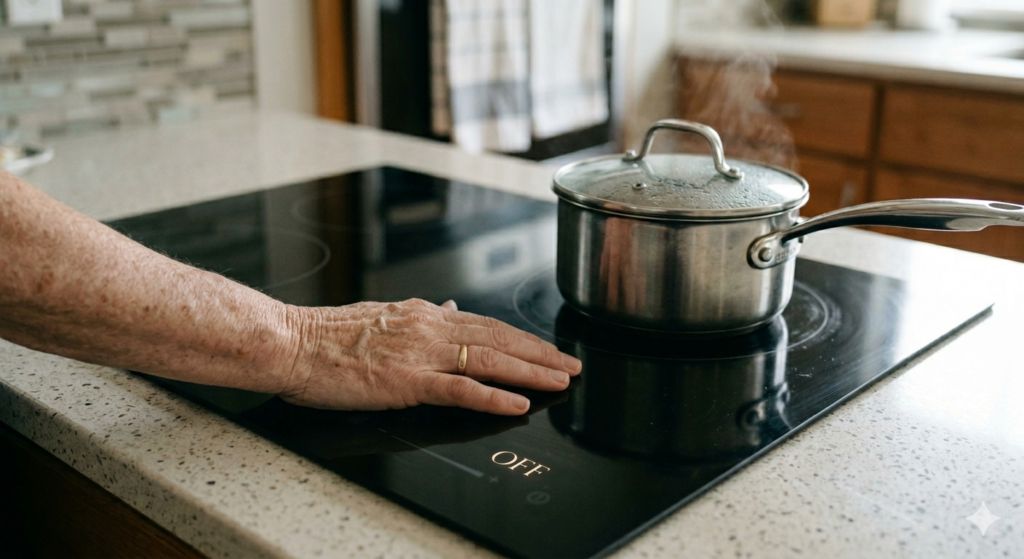
Induction cooktop with a hand resting near the cooking zone, illustrating cool-to-touch surface seconds after use.
If we were forced to pick one upgrade with the biggest aging-in-place safety impact, it would be induction. Induction cooktops heat the pan, not the surface, so the glass cools within seconds of removing the pan. A forgotten paper towel left on the cooktop doesn’t ignite. A grandchild’s hand resting on the surface doesn’t burn. The auto-shutoff on most premium models means a pot left unattended doesn’t escalate into a kitchen fire. And induction cooks fast — water boils in half the time of gas — which means less time standing at the stove.
Beyond induction, the slide-in range form factor matters more than people realize. Front controls eliminate reaching over hot burners. The continuous surface between range and counter means nothing falls into a gap. Built-in safety shutoffs across the GE Café and Thermador lines provide a second layer of protection. For a homeowner in Winchester or Wellesley deciding between a freestanding gas range and a slide-in induction, the safety math is one-sided — but the cooking experience is a real preference, which is exactly why testing in person matters.
3. Wall Ovens at a Comfortable Height
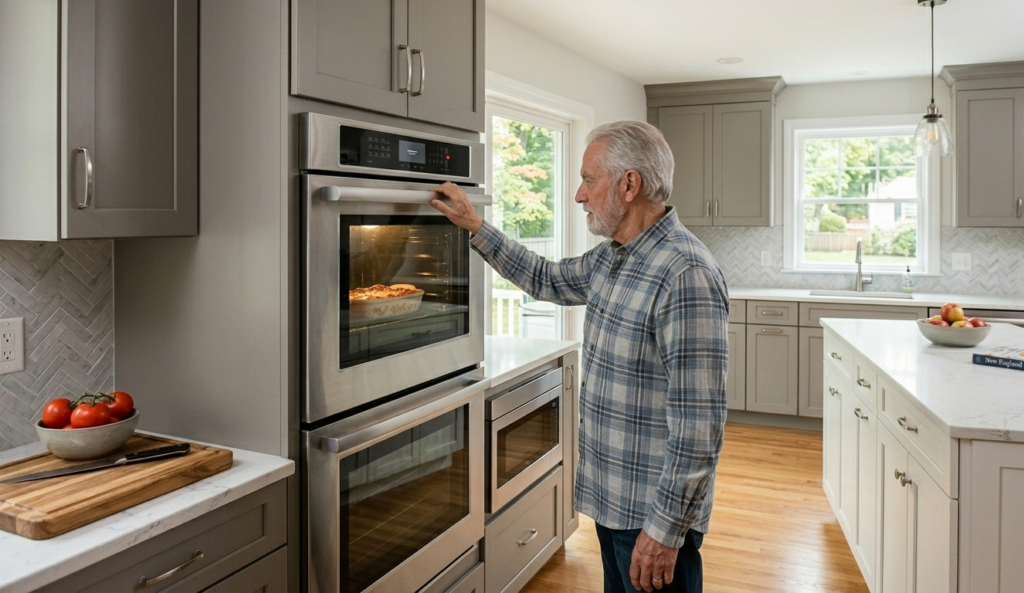
Of all the small design choices that compound over twenty years, oven height might be the most undervalued. Traditional ranges put the oven near floor level, which means every Thanksgiving turkey, every Sunday roast, every casserole, comes out of an oven you’re bending into. Replace that with a built-in wall oven mounted at chest height — typically 36 inches off the floor — and the most physical part of holiday cooking gets noticeably easier. Double wall ovens put both compartments and controls at eye level. French-door wall oven designs let you place a dish without holding the door open with one hand.
When we work with Burlington-area designers on aging-in-place remodels, the wall-oven height conversation often shifts the entire kitchen layout. Pairing a wall oven with a separate cooktop, instead of a single range, costs more up front and saves a lot of physical strain over a decade.
4. Dishwashers — Quieter, Easier to Load, Smarter About Cycles
The dishwasher is a workhorse that runs hundreds of times a year, and small accessibility wins multiply fast. Top-rack designs with a third rack at near-eye-level mean silverware loads happen standing up, not crouched. Adjustable racks accommodate the kind of mismatched pan-and-mug load a real household actually generates. Soil sensors do the heavy lifting on pre-rinsing so there’s less time standing at the sink. And the sub-45-decibel models from GE Café and KitchenAid are quiet enough that they don’t compete with conversation or television — which matters more than you’d think for anyone using hearing aids.
5. Laundry — Front-Loaders on Pedestals
Laundry is the second-most-physical room in most homes, and a single pair of choices changes that. Front-loading washers and dryers eliminate the deep reach into a top-load tub. Pedestals raise the entire unit twelve to fifteen inches off the floor, which moves the door from “squat to load” to “step up and load.” Add a few smaller wins — automatic detergent dosing so nobody’s measuring while balancing a bottle, audio alerts for anyone with vision changes, large-text control panels — and a laundry room that worked for thirty years can keep working for another thirty.
6. The Universal Features That Help Everyone
Beyond the marquee categories, a handful of details show up across every aging-in-place kitchen we help plan. Large, backlit control panels with simple interfaces. Voice control compatibility for hands-free operation. Automatic shutoff on cooktops and ovens for the inevitable distracted moment. Pull-out shelves and drawers replacing deep, dark cabinets. LED lighting inside fridges and ovens so the contents are actually visible. Soft-close doors and drawers that don’t slam. Touchless faucets for arthritic hands or hands full of raw food. Smooth surfaces that are easy to wipe down. None of these read as compromises. All of them add up.
7. What We Don’t Recommend, Even When It Sounds Good
A few features sound like accessibility wins on paper and quietly fail in real households. Complex touchscreen interfaces are common on premium appliances, but they’re harder for anyone with reduced fine motor control or limited vision than the physical buttons they replaced. Over-the-range microwaves require reaching over a stove with a hot dish — exactly the motion aging-in-place planning is trying to eliminate. Ice makers in the freezer door look convenient but consume usable storage and require maintenance most homeowners skip. Ultra-quiet appliances are wonderful — until the cycle-finished tone is too quiet for someone with mild hearing loss to notice. Each of these is fixable with the right model choice, but only if you know to ask.
What Burlington-Area Customers Actually Ask About
After enough years on the showroom floor, the pattern of aging-in-place inquiries is clear. The chart below reflects what people actually walk in asking us — not what the appliance industry guesses, and not what national surveys generalize. Use it as a starting point for your own thinking: if your household is asking different questions, that’s useful information for the conversation.
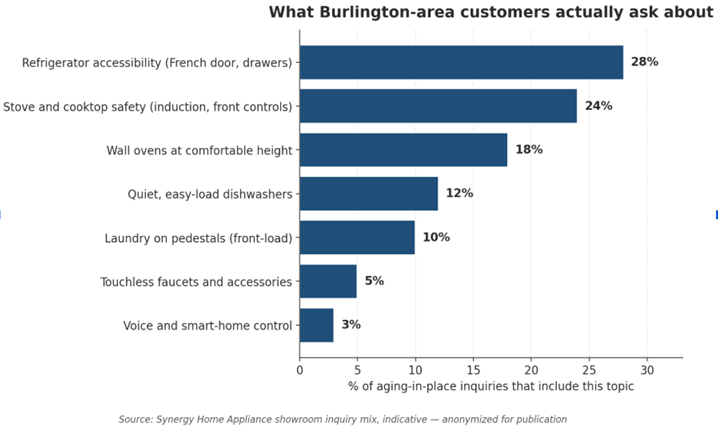
Figure: Indicative inquiry mix at the Synergy Home Appliance showroom, Burlington MA — anonymized.
Why Hands-On Testing in Burlington Matters More for This Topic
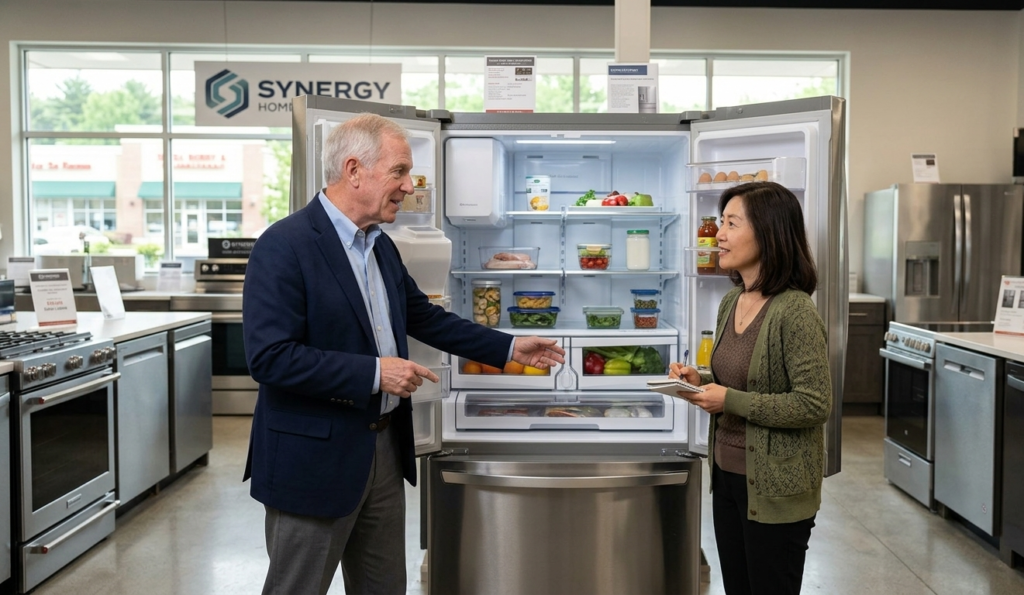
Ken Gillis with a Concord customer testing fridge clearance and shelf height in the Burlington showroom.
For most appliance purchases, online research is enough. Read reviews, compare specs, click buy. Aging-in-place purchases are different. The whole point is matching an appliance to the specific way a specific person uses their hands, their back, their eyes, their balance. That match has to be tested, not assumed.
When customers from Burlington, Lexington, Winchester, Concord, Wellesley, Weston, or any of our other service-area towns come into the showroom for an aging-in-place consultation, the test list is concrete. Open and close every refrigerator door to feel weight and clearance. Reach into displays to confirm shelf heights work. Test control panels for button readability and tactile feedback. Stand at the wall ovens to confirm comfortable working height. Experience the surfaces — the soft-close drawers, the heft of door handles, the smoothness of the operation — that no spec sheet captures.
We recently helped a Concord family upgrade for an 80-year-old father. He came in, tested three different ranges, and within fifteen minutes knew which controls he could see and operate confidently. That’s a decision you can’t make at a website.
How an Aging-in-Place Kitchen Project Actually Works at Synergy
Whether you’re planning a full remodel or replacing one appliance at a time, the process we use for aging-in-place projects is the same. We start with a conversation about how the kitchen is actually used today — who cooks, who cleans, who hosts holidays, who lives in the house now and who might live there in five years. Then we walk through the showroom together, testing the appliances that match those needs. We share practical design advice on placement and layout (we work with most of the Burlington-area kitchen designers and contractors regularly, so we can talk in their language). When the decisions are made, our installation team handles positioning and connection so the final result actually performs the way it tested. After the install, we stay reachable — questions about settings, shelf adjustments, manufacturer service — none of that ends at delivery.
Designers and contractors in our service area: we run a dedicated trade program with project pricing, dedicated account support, and joint client consultations. If you’re working on an accessible-kitchen project anywhere from Burlington to Wellesley to Sudbury, get in touch directly.
Mass Save Rebates and Federal Tax Credits Worth Knowing in 2026
One of the consistently overlooked parts of an aging-in-place appliance upgrade is the rebate stack. Massachusetts is one of the more generous states for energy-efficient appliance incentives — and many of the appliances on the aging-in-place shortlist (induction cooktops, ENERGY STAR refrigerators, heat pump dryers, ENERGY STAR dishwashers) qualify.
Mass Save administers most of the residential rebates in Massachusetts on behalf of the major utilities. The exact amounts and qualifying models update annually, but the pattern holds year over year: induction cooktops and ranges, heat pump clothes dryers, and high-efficiency refrigerators routinely qualify for rebates that meaningfully offset the price difference between a basic model and the better-designed accessible equivalent. Federal tax credits under the Energy Efficient Home Improvement Credit (Section 25C) layer on top for additional savings on qualifying purchases.
We track current Mass Save qualifying models continuously — it’s part of every aging-in-place consultation we run. Bring your project to the showroom and we’ll show you which of your shortlist qualifies before you buy, not after.
→ Email digital@synergyhomeappliance.com with subject “Aging-in-Place Checklist” or visit synergyhomeappliance.com/aging-in-place-checklist to download.
Frequently Asked Questions: Aging in Place and Kitchen Appliances
Won't accessible appliances look institutional or "elderly"?
Should I wait until I actually need these features before upgrading?
Will accessible appliances actually cost more?
Can I retrofit existing appliances or do I have to replace them?
Are there Mass Save rebates available for aging-in-place appliance choices?
Do you offer in-home appliance consultations?
How long does a typical aging-in-place kitchen project take from planning to install?
Do you work with designers and contractors directly?
Visit the Burlington Showroom — and Let’s Plan the Kitchen You’ll Still Love at 85
The kitchen you cook in at 65 should be the same kitchen that works at 85. Not a remodeled-twice compromise. Not an institutional retrofit. The same beautiful, well-designed kitchen — just chosen well from the start.
Come into our Burlington showroom this week and walk through it with us. Bring your spouse, your adult kids, your parents, your designer, your contractor — whoever is part of the decision. We’ll show you the appliances, talk through the trade-offs, run through Mass Save eligibility on whatever you’re considering, and give you real answers based on 35 years of conversations with families in your exact situation.